
Finite Element Analysis of a Rope Wound Around a Capstan Drum

Updated: Feb 22
You don't need to be a pirate or sail the high seas to enjoy an analysis of a rope wound around a capstan drum, although it probably doesn't hurt either.

When a flexible tensile member, such as a rope, belt, or chain, is wrapped around a drum, the tension in the member creates a normal force that is perpendicular to the surface of the drum. This normal force, coupled with the friction between the flexible tensile member and the surface of the drum, reduces the tension in the flexible member.
This may seem a little strange to non-seafaring folks and non-pirates, so let's look at the equations themselves and a simple example problem to see how they can be practically applied.

Let's start with a simple example, and then we will move on to something more complex.
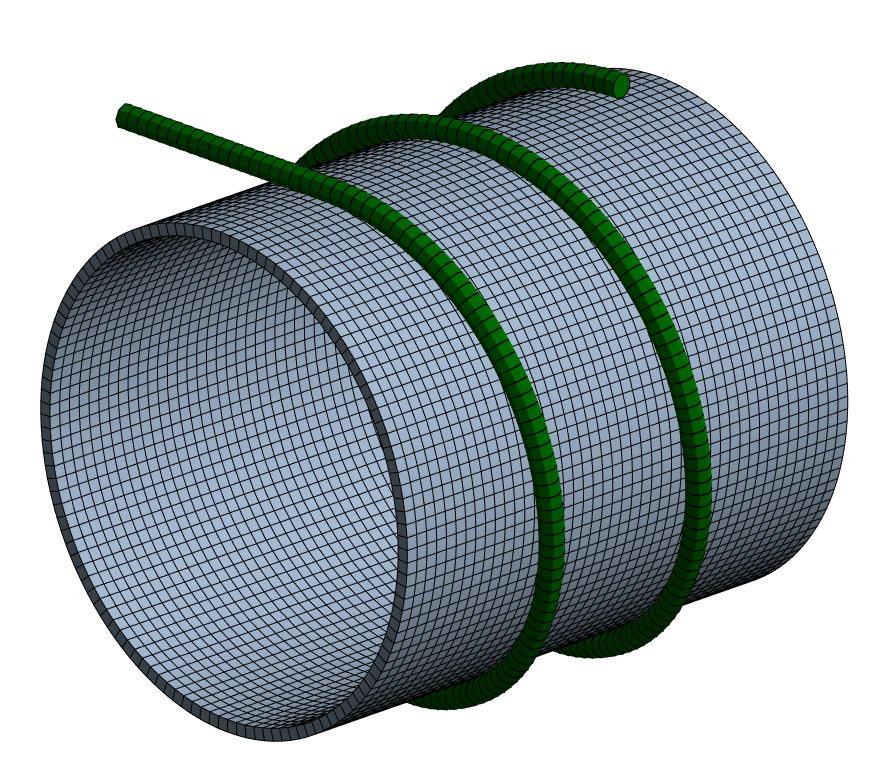
Here we have a blue drum and a green rope. One end of the green rope is firmly fixed to the side of the drum, and a load is applied to the other end of the rope tangentially to the drum.

If the coefficient of friction between the rope and the surface of the drum is 0.2, how much tension is in the rope where it attaches to the drum if we apply a load of 1,000 lbf to the other end?
If there were no friction, this would be simple. A force of 1,000 lbf applied to one end of the rope would mean that we need 1,000 lbf applied in the opposite direction at the other end to prevent free-body motion of the rope.
However, with friction included, the tension in the rope decreases along the circumference of the drum. Luckily, the Capstan Equation is very easy to implement in this simple example.

Now that we have a better understanding of the Capstan Equation and its practical application, let's see if we can solve a slightly more complex example using the Finite Element Method. Because this is a nonlinear problem that includes contact, we will need to use ANSYS Mechanical as our finite element analysis software.
For this example, we will use a 1.0-inch drum and a 0.1-inch-diameter rope that is wrapped twice around the drum. The coefficient of friction between the rope and drum will be set to 0.15.

To simplify the FE modeling process, the drum was modeled as a midsurface so that it may be meshed with shell elements, and the rope was modeled as a line body. If anyone would like this CAD model, please contact me, and I will send it your way. The geometry was meshed with a default element size of 0.05 inches.
The rope's model type was set to "Cable," and its cross section was defined with a radius of 0.05 inches.


A contact will be created between the line that represents the rope and the midsurface that represents the drum.

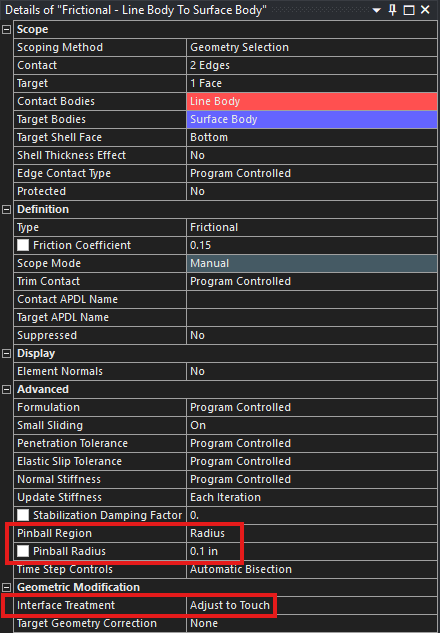
Because the rope is modeled as a line body and the drum is modeled as a surface body, the pinball radius for this contact needs to be sufficiently large to capture the interaction between these different bodies. For this geometry, the pinball radius was set to 0.1 inches. The interface treatment was set to Adjust to Touch to eliminate any gaps that may exist within the modeled geometry.
To attach the end of the rope to the drum, we will use a bonded contact. For this contact, we will set the pinball radius to 0.1 inches.

Okay, my seafaring crew, let's apply some constraints.
We aren't concerned with the drum or the forces applied to it, so the drum will simply be fixed. This may not always be appropriate, so proceed cautiously when fixing large portions of your model.

We can now apply a 400 lbf force to the end of the rope. This force is applied collinearly to the line that represents the rope.

Any good seafaring crew knows they must plan ahead, as the ocean can be an unforgiving place. Because this is a nonlinear model that utilizes cable elements, we must turn Large Deflection on in the Analysis Settings. We should also use Step Control to verify that our loads are applied slowly and to aid in convergence.

Let's solve this nonlinear model and see if we can identify some useful results. This relatively simple FE model solves in under 17 seconds, despite the nonlinear contact and Large Deflection.
When we look at the contour plot of the axial tension in the rope, we see how the friction between the drum and rope reduces the axial tension in the rope.

Before we accept these results, let us evaluate this second example using the Capstan Equation.

The hold force identified using ANSYS Mechanical was 60.81 lbf, while the hold force identified using the Capstan Equation was 60.73 lbf, resulting in an error of less than 0.125%. This represents excellent correlation between a finite element model and the Capstan Equation. This trend holds up for a variety of coefficients of friction. Again, this highlights just how far the Finite Element Method has progressed: contact between cable elements and shell elements accurately approximates friction and holding forces in a complex nonlinear model.

Thank you for taking the time to read this article, and please contact me if you have ideas for future articles.
John Parsons
Analyst
MESim LLC


Comments